
Most organizations invest heavily in ERP platforms, transformation programs, and AI technologies, yet struggle to translate those investments into consistent, measurable operational outcomes.
The root cause is rarely the technology itself. It is the absence of a shared, trusted understanding of how work should run across the enterprise.
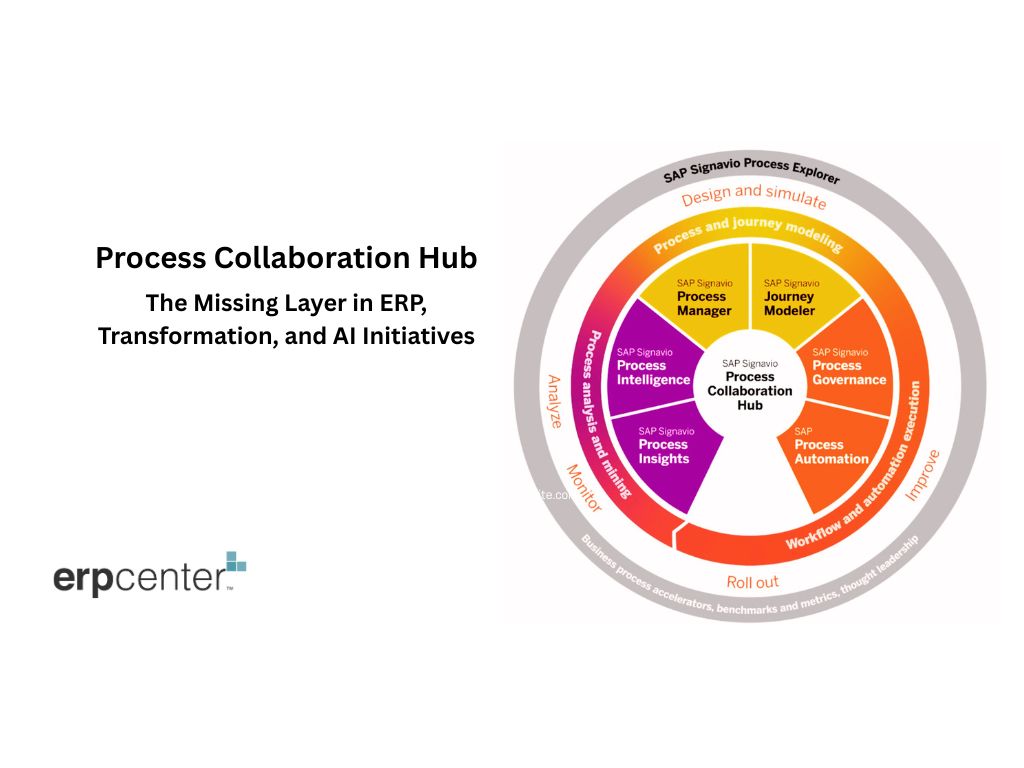
This is where SAP Signavio Process Collaboration Hub plays a critical role—acting as the connective layer between systems, strategy, and execution.
ERP Perspective: Making ERP Executable for the Business
ERP programs are often positioned as process standardization initiatives. In practice, many ERP efforts fall short because:
- Process decisions are locked in design documents rather than embedded in daily work
- Business users lack visibility into end-to-end processes
- Changes introduced during ERP rollouts are not clearly communicated
- Teams revert to legacy behaviors after go-live
ERP systems execute transactions. They do not explain how work flows across functions.
Process Collaboration Hub fills this gap by providing a single, navigable source of process truth that business and IT can align around. It makes ERP-enabled processes understandable, accessible, and governable long after implementation.
The result is higher adoption, faster stabilization, and a stronger foundation for continuous ERP optimization.
Transformation Perspective: Turning Strategy into Operational Reality
Most transformation initiatives fail not because the strategy is flawed, but because execution lacks clarity.
Common challenges include:
- Transformation goals disconnected from frontline execution
- Process changes communicated inconsistently across teams
- Unclear ownership for evolving ways of working
- Limited feedback between design and actual operations
Transformation requires more than vision and roadmaps. It requires operational clarity at scale.
Process Collaboration Hub enables organizations to translate strategic intent into clear, owned, and continuously evolving processes. It creates transparency without bureaucracy and embeds change into how work is actually performed, not just how it is planned.
This is how transformation moves from a temporary program to a sustainable operating model.
AI Perspective: Why AI Needs Process Context to Succeed
AI initiatives promise automation, optimization, and intelligent decision-making. Yet many AI programs stall because:
- Processes are inconsistent or poorly understood
- Decision logic is undocumented or ambiguous
- Exceptions dominate execution
- Ownership of process decisions is unclear
AI does not replace process. It amplifies it.
Process Collaboration Hub provides the context AI needs to be effective. It allows organizations to understand where automation makes sense, how decisions should be made, and how changes driven by insights are communicated back to the business.
When process clarity exists, AI moves from experimentation to enterprise-scale impact.
One Platform, Multiple Strategic Outcomes
Whether viewed through an ERP, transformation, or AI lens, Process Collaboration Hub delivers the same foundational value:
- A shared understanding of how work should run
- Explicit ownership and governance
- Clear communication of change
- A continuous improvement loop grounded in reality
It becomes the common language that connects people, systems, and intelligence.
Final Thought
Organizations rarely fail due to a lack of technology, strategy, or data. They fail when the organization does not share a clear, trusted understanding of how work is meant to happen.
SAP Signavio Process Collaboration Hub turns process into that shared understanding— one that ERP systems can execute, transformation programs can govern, and AI can enhance.
At ERP Center, we see SAP Signavio Process Collaboration Hub as a critical enabler for turning strategy into execution. When implemented with intent, it helps organizations move from documenting processes to operating with clarity, accountability, and confidence.