
Southern California utilities operate in one of the most complex operating environments in the country. Wildfire risk, aggressive decarbonization mandates, aging infrastructure, labor constraints, and heightened regulatory scrutiny are not episodic challenges—they are permanent operating conditions.
For CIOs, COOs, and operations leaders, the question is no longer whether to modernize processes, but how to do it in a way that improves productivity, reduces operational risk, and stands up to regulatory scrutiny—without disrupting day-to-day service delivery.
This is where Business Process Management (BPM) has evolved from a documentation exercise into a core execution capability, and where SAP Signavio is emerging as a practical enabler of measurable operational improvement.
The Southern California utility reality: complexity at scale
Utilities in Southern California face a convergence of pressures that amplify process inefficiencies:
- Wildfire mitigation and safety compliance require repeatable, auditable processes across planning, execution, and reporting.
- Customer operations volatility (PSPS events, outage credits, claims, billing disputes) drive unpredictable workload spikes.
- Field operations coordination spans internal crews, contractors, asset systems, and regulatory checkpoints.
- Capital and O&M spend accountability demands traceability between approved funding, executed work, and outcomes.
In this environment, even small process inconsistencies translate into:
- Higher call volumes and repeat contacts
- Increased truck rolls and rework
- Longer cycle times and backlog growth
- Greater compliance and audit exposure
Technology alone does not solve this. Execution discipline does.
Why traditional BPM falls short for executives
Most utilities already “have BPM.” What they often lack is process truth.
Typical gaps include:
- Process documentation that reflects intent, not reality
- Limited visibility into where work actually stalls or loops
- No linkage between process variants and cost, risk, or customer impact
- BPM owned by a single function instead of shared across IT, operations, and business
For CIOs and COOs, this means BPM initiatives struggle to translate into enterprise-level productivity gains.
SAP Signavio: BPM designed for operational leadership
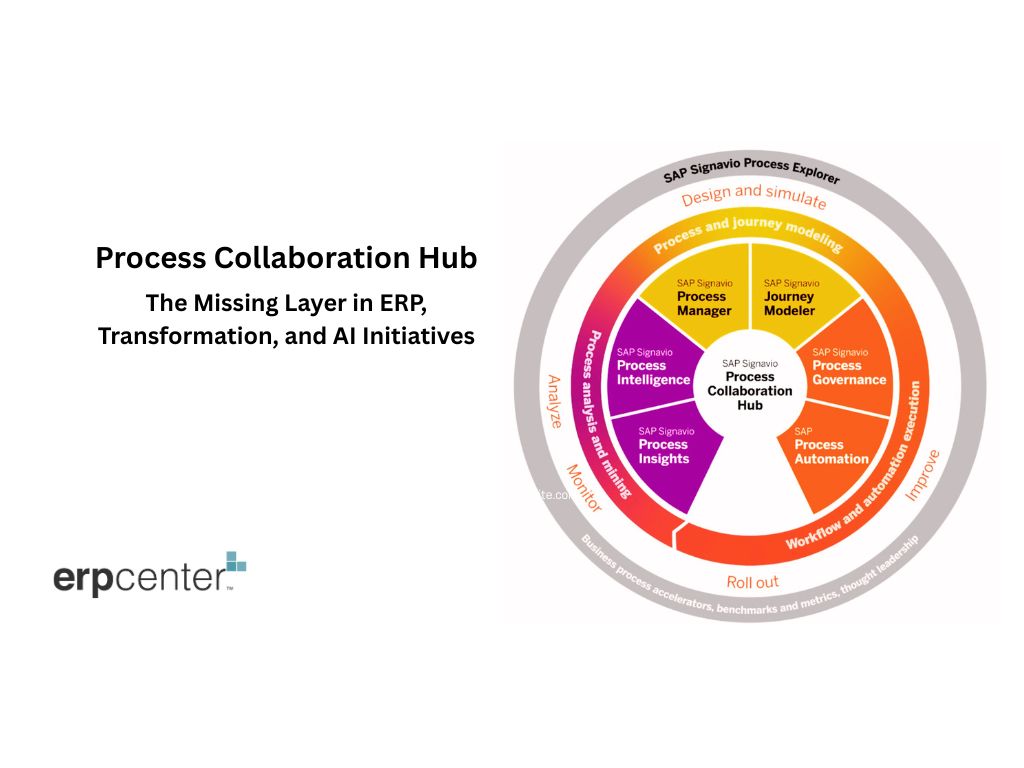
SAP Signavio is not just a modeling tool. It is a process intelligence and governance platform that aligns how work is designed, executed, measured, and improved—continuously.
For executive leaders, its value shows up in four areas.
1. From assumptions to facts: visibility into real execution
Signavio’s process intelligence capabilities reconstruct actual end-to-end flows using system data, revealing:
- Where work queues form
- Which process variants drive the most rework
- How often exceptions occur—and why
For utilities, this is critical. The biggest cost and risk drivers are almost always exceptions, not the happy path.
2. Productivity improvement that is targeted, not theoretical
Instead of broad transformation programs, Signavio enables leaders to:
- Prioritize the few processes that drive the most cost or customer friction
- Quantify the impact of process changes on cycle time, backlog, and first-time-right rates
- Track improvement over time with operational KPIs, not just project milestones
This supports a portfolio approach to productivity, which resonates with both CIO and COO priorities.
3. Stronger governance across regions, vendors, and contractors
Southern California utilities operate across multiple service territories and contractor ecosystems. Process drift is inevitable without shared visibility and governance.
Signavio provides:
- A single, governed process repository
- Controlled versioning and ownership
- Cross-functional collaboration between IT, operations, compliance, and business teams
This helps standardize execution without over-centralizing decision-making.
4. Auditability and compliance by design, not by exception
Regulators and auditors increasingly expect utilities to prove execution, not just intent.
By aligning process design with actual execution data, Signavio helps:
- Identify where required steps are bypassed or delayed
- Strengthen internal controls without adding manual overhead
- Improve readiness for audits, safety reviews, and compliance reporting
For executives, this directly reduces operational and reputational risk.
High-impact utility use cases CIOs and COOs care about
In Southern California utilities, BPM-led productivity gains often come fastest from:
Customer Operations
- Billing disputes and adjustments
- Move-in / move-out and service connections
- Outage credits, claims, and escalations
Field & Asset Operations
- Inspection-to-work-order-to-closeout flows
- Vegetation management and compliance tracking
- Contractor coordination and documentation quality
Safety & Risk-Adjacent Processes
- Wildfire mitigation execution tracking
- Incident reporting and internal investigations
Each of these areas combines high volume, high visibility, and high risk—making them ideal BPM candidates.
While SAP Signavio provides the process intelligence and transparency utilities need, technology alone does not deliver outcomes. The real differentiator is how effectively insights are translated into operational change, governance, and sustained execution.
This is where ERP Center brings differentiated advisory leadership to help customers turn insight into execution.